

Now that we know what incomes are, let’s discuss why understanding the nature of one’s income is crucial to financial planning and which types of income must be considered while preparing one’s personal budget.
As mentioned earlier, Income refers to the relatively regular inflow of resources every month or year, or any other time period. In simple terms, it represents your pool of resources every period, out of which you spend on your needs and save the rest. The concept of Income merits careful attention since both Expenses and Savings must happen out of this number. This implies that a miscalculation of your income number can not only make it difficult for you to meet your monthly expenses, it can also throw your saving plans out of gear.
To be able to understand your income, it is also critical to understand the distinctions between Active and Passive Income, and Certain and Uncertain income.
So here we go:
Active versus Passive Incomes:
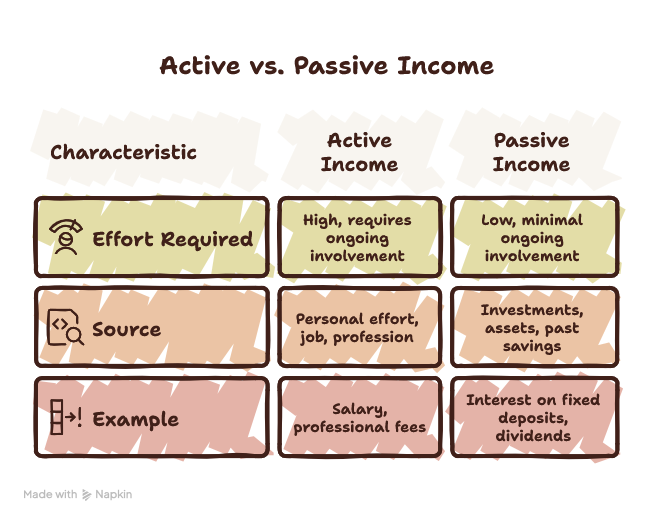
Active Income refers to the income that YOU earn month on month, through your own effort and involvement. For instance, income from salaries or professional fees. Take the example of a doctor. His active income comes out of the fees he receives from consulting in hospitals and fees received out of private practice. If one day disaster strikes and he meets with an accident, he can no longer go to work. All of his Active Income is gone! Gone because he is no longer able to report to work, the very requirement for earning this type of income. This makes active income risky, in terms of adverse events that could impact one’s ability to work.
Passive Income refers to that part of one’s income that is earned without one’s active involvement. These usually result from past savings that have been invested in income-generating assets. Think of receipts such as interest on fixed deposits, dividends on shares purchased etc. These incomes gives us financial security, assuring us of a minimum level of income and consumption even if we were not able to earn any active income in a certain period. For the elderly and retired, pensions constitute passive income.
Certain versus Uncertain Incomes:
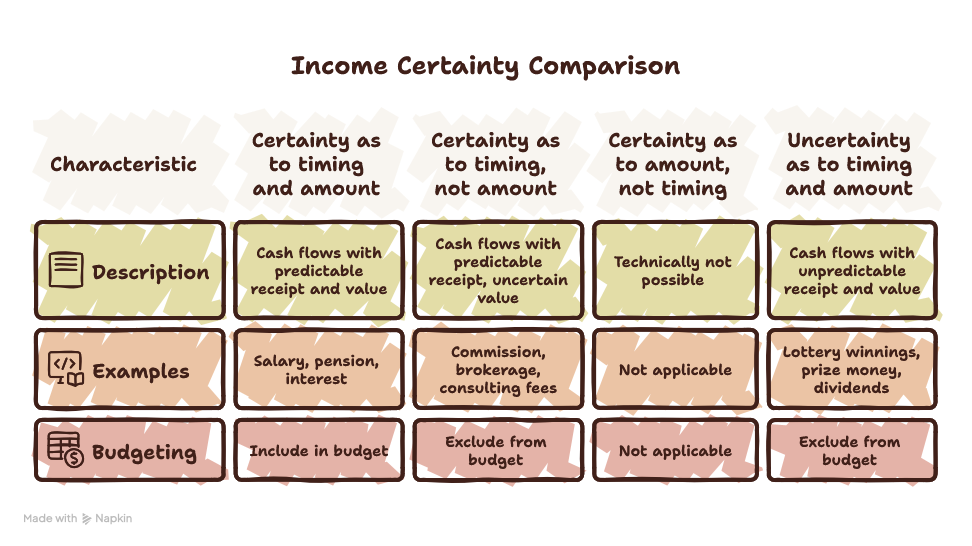
This classification of income enables you to ascertain the element of ‘certainty’ in your income flows. Certainty in income can relate to two things – certainty in timing and in amount. The most certain income flows are those that provide assurance both in terms of timing and amount.
While in any given period, our total income may comprise both certain and uncertain incomes, a larger share of certain income assures us of peace of mind, through greater predictability. Human beings thrive while they feel in control. No or little control generates anxiety and inability to predict or plan.
In terms of certainty, incomes could take the following four forms:
Some points to remember:
- Certain incomes are better than uncertain ones, for they allow us the luxury of planning and budgeting. Greater the uncertainty in income, greater the financial anxiety.
- Active incomes are more common in younger years, when we are active earners. This time is best suited to keep aside savings that could be used to generate passive incomes in the future.
- Passive incomes should ideally grow as we age, to compensate for loss of active income over time.
Let’s do a quick exercise. Consider your total income for the last month, including all sources. Assess what part of this income is certain or expected to continue in the future. Also, are you earning any passive incomes, as a result of your past savings and investments? Even if you have no or little passive incomes today, one goal you could have for yourself is to create a system of investments that could guarantee you of increasing passive incomes over time, to prepare you better for your retirement years.
Thank you for reading.
Leave a Reply